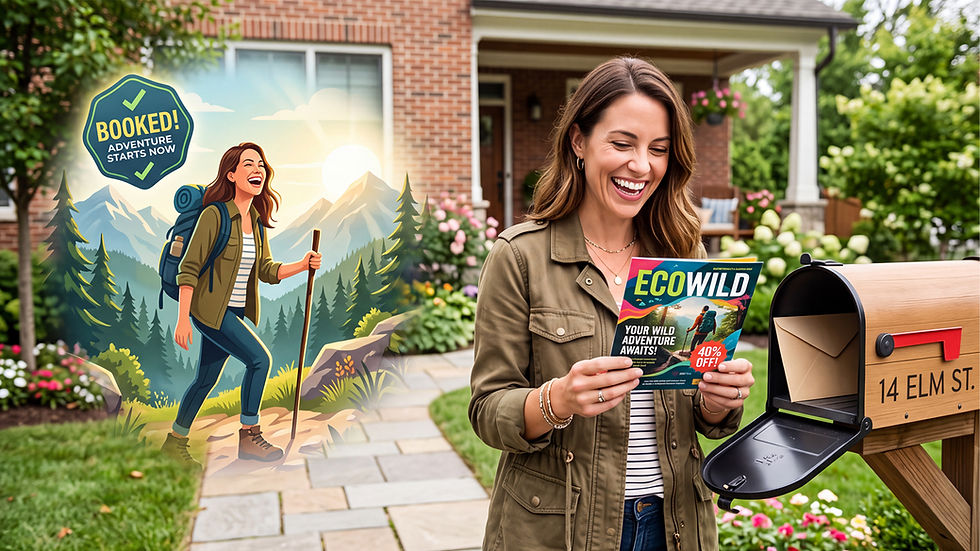
What 2025 Taught Us About Direct Mail — And What’s Next for 2026


2025 was not a year for shortcuts.
Inbox fatigue increased. Digital noise intensified. Attention became harder — and more expensive — to earn. In that environment, direct mail didn’t just survive. It proved that when done with intention, it still delivers results.
Over the course of the year, we broke down what worked, what didn’t, and why. The takeaway was clear: direct mail isn’t about volume anymore. It’s about precision.
Here are the most important lessons from 2025 — and how they should shape your 2026 strategy.
Lesson 1: Your List Is the Foundation
No offer can save a bad list.
We saw it repeatedly: campaigns with strong creative and solid messaging still underperformed because the audience was too broad, outdated, or misaligned. Meanwhile, smaller, cleaner lists consistently delivered better engagement.
For 2026, list quality is no longer optional. Clean data, proper segmentation, and intentional targeting will outperform bigger sends every time.
Better targeting beats bigger volume.
Lesson 2: Design Determines Whether You Get a Chance
Mail doesn’t fail quietly. It fails instantly.
If a piece looks cluttered, generic, or rushed, it gets treated like junk before it’s opened. Design is not decoration — it’s the filter that determines whether your message earns attention.
What worked in 2025 was restraint:
Clear hierarchy. Strong headlines. Clean layouts. White space that signaled value.
If your mail doesn’t look intentional, it won’t get read.
Lesson 3: Timing Is a Strategy, Not a Detail
The right message at the wrong time is still the wrong message.
Campaigns that aligned with real-world moments — budget cycles, seasonal needs, enrollment periods, or buying windows — consistently outperformed those sent “when ready.”
The biggest shift we saw was planning backward: starting from the desired in-home date, then accounting for production and delivery timelines.
In 2026, timing needs to be designed into the campaign — not decided at the last minute.
Lesson 4: One-and-Done Campaigns Don’t Work
Single mailers rarely convert on their own.
The campaigns that performed best treated direct mail as part of a sequence — not a standalone event. Follow-up wasn’t an afterthought. It was the plan.
Multi-touch strategies that combined print with email or digital reinforcement created familiarity, trust, and response.
Consistency isn’t redundancy. It’s credibility.
Lesson 5: Personalization Is the Baseline Now
Generic messaging is easy to ignore.
In 2025, personalization moved from “nice to have” to expected. Variable Data Printing (VDP) allowed campaigns to feel relevant at scale — without sacrificing efficiency.
Names, locations, timing cues, and contextual messaging made mail feel like it belonged to the recipient.
If it looks mass-produced, it will be treated that way.
Lesson 6: Gratitude Builds What Ads Can’t
Not every touch needs to sell.
Thank-you campaigns — post-sale, post-event, seasonal — consistently strengthened loyalty and retention. They worked because they felt human, not transactional.
In a year where everyone was selling something, appreciation stood out.
Gratitude isn’t soft. It’s strategic.
What This Means for 2026
The path forward is clear:
Fewer random sends
Better planning
Cleaner data
Smarter sequencing
Stronger integration between print and digital
Direct mail in 2026 will reward intention, not impulse.
Brands that win will do fewer things — but do them better.
Looking Ahead
At Chroma, we see 2026 as an opportunity to refine, not reinvent. The fundamentals are proven. The difference will be in execution.
If you’re planning your 2026 campaigns, now is the time to align your lists, timing, design, and follow-up strategy.
Reach us at info@chromadi.com to start planning what’s next.